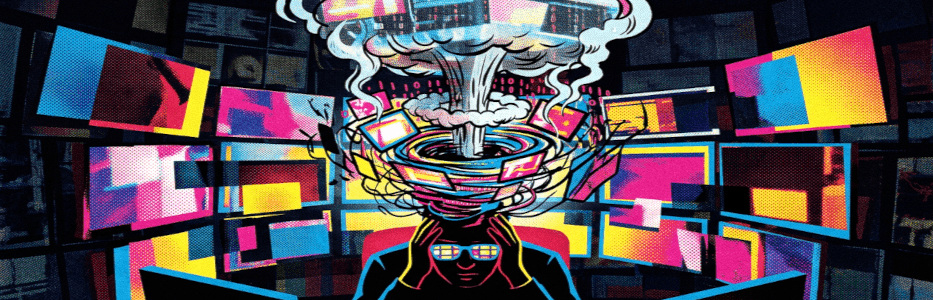
MELBOURNE: Artificial intelligence is emerging as the new frontier for psychosocial compensation claims as businesses reckon with workers’ anxiety over technological replacement or AI “brain fry” from supervising multiple agentic bots, experts say.
The potential hazards come as psychosocial worker compensation claims are growing by 10 per cent a year, based on Safe Work Australia data from the past five years, even as physical workplace injuries decline.
The growth has meant total compensation claims shot past $1 billion in 2023-24, more than double 2018-19 and five years earlier than the Committee for Economic Development of Australia projected in 2021.
Michael Tooma, leading work health and safety lawyer at Hamilton Locke, said AI was now adding new psychosocial risks that exposed businesses to even more compensation claims. But the technology was also prompting a “remarkable” rethink.
“The debate a year or so ago was really leadership trying to understand more about the psychosocial levers, and almost some level of pushback over whether that was something businesses should be dealing with,” he said.
“Now there’s a high degree of acceptance of the psychosocial risk when it comes to the role of AI and what it plays in that space, which is a huge shift over a short period of time.”
Psychosocial risks generally have already resulted in big changes for business. Last year mining firm Cobar Management had to spend more than $1 million on a safer workplace after its restructure left two accountants with excessive workloads.
University of Technology Sydney was also forced to pause its redundancy round because the regulator said the way it managed the process risked workers’ mental health.
In the early stages of the AI revolution, tech sector job cuts and repeated refrains that AI will replace jobs have created their own kind of stressor.
A third of Australians believe their job will disappear due to AI in the next half-decade, according to a workforce survey data in March by recruiter Randstad.
“People are having a level of anxiety that they’re basically training the technology that’s going to take away their jobs,” Tooma said. “You can easily spiral into doom and gloom, and that leads to bad health outcomes.”
And as much as AI promises to reduce workloads it also risks making them more intense.
A Boston Consulting study of 1488 US-based employees, published in April, found workers’ intense oversight of AI agents was creating “AI brain fry” – a “buzzing” or acute mental fog arising from intensive back and forth and verification of the tools.
One respondent described it as having “a dozen browser tabs open in my head, all fighting for attention”.
The result was difficulty focusing, slower decision-making and headaches such that some workers had to physically step away from their computer to reset.
“We think of cognitive overload in terms of just hours of work, but this might be small doses of work, or normal working hours, but the intensity is such that you’re still exposed to risks to your health and safety,” Tooma said.
“So how do you now deal with that in that context? How do you rotate people in and out? How do you develop different tools? How do you build people’s concentration for prolonged periods for that task?
“In many respects the psychosocial label is almost unhelpful in that it suggests that this is just another application of the same concepts to a different circumstance. But the scale of change is so vast and so extensive that actually it might require rethinking how we deal with those issues.”
Former Australian Human Rights Commissioner Ed Santow, now director at the University of Technology Sydney’s Human Technology Institute, said research was finding AI was reducing workers’ capacity to do normal parts of their job, which created its own stressor.
“There are many more tasks or activities where essentially we’re outsourcing the thinking work,” Santow said.
“From that, two consequences are arising. You understand the issue less well. You get a response but if someone asks you to explain your response or come to it from a different angle you become less able to do that. You lose the knowledge and you lose the skill. Then people feel stressed in performing tasks that are core to what you’re employed to do.”
There were ways to counteract that, he said. “It’s not inevitable when using AI, but it’s a real problem – and that problem hadn’t arisen before we started using AI.”
Dr Angie Montgomery, managing director of psychosocial software firm InCheq, argued AI could be captured by the existing laws and prevention techniques.
“AI is an accelerant, but it is an accelerant of existing systems,” she said. “Job insecurity, work intensification and erosion of role clarity are not discrete problems requiring separate interventions.
“They are interconnected consequences of the same failure: deploying AI without a transformation strategy that defines what roles, tasks, and workflows exist on the other side, and how the transition itself could cause harm.”
But Tooma believes a rethinking of risk management was necessary to deal with AI.
“More so than anything else this is about capacity building. This is about enabling people to build new skills and a mindset shift to embrace the change – more akin to a change-management exercise than the traditional risk management is designed for,” he said.
“Our throwback to the traditional view is stop the process, let’s consult some more, but the technology is not going to wait for you. So you have to rethink the way you are engaging with an issue and develop new tools for managing the consequences.
“It’s the same way that the steam engine developed a whole world of laws, which we now call industrial safety laws.”