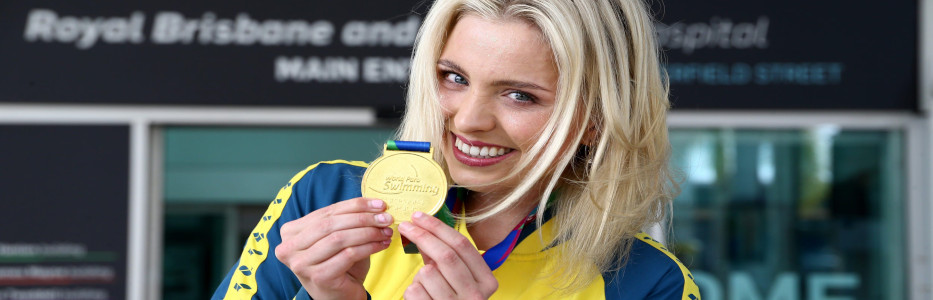
SINGAPORE: The teenage younger brother of Paralympic swimming golden girl Alexa Leary is frantic.
Jack, 17, can’t get hold of his sister – whose been battling depressive episodes – after earlier agreeing to drive and drop her for a solo walk at the Sunshine Coast’s Noosa National Park.
She’d wanted to “clear her head”, she’d told him. Jack recalls on the drive he was “playing songs”.
“I was trying to make her happy because she was definitely a bit down. It was easy for her to go downhill because of the shaved head, no licence, and not many close friends.
“I dropped her off at the beach. She really wanted to be on her own. She always had everyone around her. I was just like, I’ll let her do her thing, I’ll wait around, make sure it’s all alright.”
The afternoon “quickly turned dark” – much like the thoughts of her family who began fearing the worst as time dragged, unable to contact her.
“I remember getting messages from mum and dad… ‘where is she?’. I sped back to the beach.
“I started running on the sand. I asked everyone. Have you seen Alexa Leary? It was a big panic. You’re just thinking the worst.
“I was running up those stairs and through the national park, screaming out for her. Your heart just kind of stops.”
It is months after her release in November, 2021, from hospital – 111 days after she miraculously survived a high-speed Sunshine Coast road cycling smash at Pomona that split her head, broke her ribs and scapula, punctured her lung, shattered her right leg and obliterated her knee.
She defied medical predictions she would not survive, and if she did would have “no quality of life” due to severe brain trauma. To doctors’ amazement she didn’t just keep breathing when they switched off her life support, she started walking and talking again.
Her competitive spirit, channelled before the accident into becoming a world-class triathlete – and channelled after it to win two golds and a silver in the pool at the Paris Paralympics in one of the inspirational moments of the Games – was renowned.
Among her first words when waking from her coma was a typically determined “I’m f–king back” to her family’s amusement, but not surprise.
But her new reality coping daily with a traumatic brain injury has been a battle for and her family.
Jack – who calls his sister his “role model” – had come out of hospital “like an angel, so happy to be out”.
“Smiling every day, so grateful. But that slowly came to an end. You could definitely see her changing,” he says, opening up about the day his older sister came close to taking her own life.
The reality in those early months of recovery was stark – Alexa’s head had been shaved due to surgeries including the lifesaving removal of part of her skull. She was unable to drive, losing a big part of her independence. And due to erratic moods and at times extremely inappropriate behaviour due to her brain trauma, many friends had deserted her.
After Jack had dropped her off for her walk at the beach, Alexa had made it to the top of Hells Gates, perched over a drop to the sea and rocks.
“I was so down. I did get this lady, when I tried to do something to myself, she did catch me. I don’t even know her name. I’ve got goosebumps (talking about this).
“She caught me and she said ‘What are you doing?’. She walked with me. She just walked with me for a little bit.”
She finally messaged her brother to say “I’m here”.
“He’s balling his eyes out. I was crying with him. It was just a tough moment for me because I was happy to leave because of how sad I was,” Alexa says.
“I was just a lost little creature. I was so sad. I had no hair, no friends. They all left. They had no acceptance or understanding of my brain damage. It was really hard for me.”
Jack recalls: “She told me how she was sitting on the edge of the cliff, thinking about ending it all and I just told her ‘That’s not the way out – Alexa, you can’t do this to your little brother’. It’s not alright. You’ve got so much to live for, look four years down the track, you can turn your life around.”
Father Russell reflects: “Thank heaven we found her because that night, she was gone. She had tried a couple of other times. We had to work out we’ve got to fight through this.
“A lot of brain damaged people commit suicide because they lose everyone because of their anger. With brain damage, your emotions are high and low so you can have it every emotion within a minute. Happy, sad, angry, all over the place – so it’s hard to keep on the straight and narrow.”
Early in her recovery at home she physically attacked Russell and Belinda. For a while, police and ambulance calls were weekly.
“A typical day with Lex is like a roller coaster,” Russell says. “A nightmare rollercoaster. It wasn’t Alexa – wasn’t her fault. It was the brain injury. She lost all her friends because of her anger.
“When you see Alexa on the world stage, nobody knows what happens behind closed doors. With a traumatic brain injury, it’s just so tough on her.
“She became physical because she became angry. She can’t control that. She would hit out at us. I’d have black eyes, blood everywhere.
“She would scratch your arms and hands to pieces. We felt for her, it was just so upsetting for everybody. But we just had to have hope and get through.
“I felt for Jack who would pull her off us. We worked through it because we knew there had to be light at the end of this tunnel – we never gave up.”
Belinda remembers one of her own violent incidents at home with Alexa: “Next minute her hand is on the back of my head. She’s a lot taller and bigger, like athletic. And my whole head just went spinning around the kitchen and I’m like ‘Oh my god, where is my face going? ‘I’m going to end up in the stove, the sink, the fridge’.”
Jack intervened, physically pulling Alexa off, yelling ‘Let go of mum’.”
Belinda recalls: “Alexa just went into one of her seizures – the lights are on but no one’s home. She just sat there for an hour. She’s got no memory of it. It was just the brain damage – something I had said just set her off.”
Alexa adds: “I could not control my anger. I was so aggressive. Now it’s a bit better.”
The Learys have shared the harrowing side of their daughter’s incredible survival and ongoing recovery to help highlight awareness around traumatic brain injuries.
A book about her incredible life by Penguin – Sink or Swim: Defying the Odds, The remarkable story of Alexa’s second life – is available from Tuesday and the family hopes will create even more awareness.
It is an uplifting story – about a rising triathlete who defied the odds to survive a horror smash – and not just to win medals but run the New York Marathon last year with her family and continuing to strive and improve from her injuries and deal with her brain trauma.
“It’s a great read and it’s real,” Belinda says. “I said to her when we first starting talking to the ghost writer, ‘You gotta tell the good, the bad and the ugly’. We gotta talk about everything, be completely honest.
“You can’t sugarcoat anything, because this is how people are going to understand what a traumatic brain injury is really about.
“Lex can’t help her outbursts. People need to be more understanding, more compassionate and don’t take it personally. If she’s gonna swear at you or something comes out of her head like Tourette’s don’t take it personally. People with traumatic brain injuries literally can’t help it.
“On the outside, people see Lex as this beautiful, stunning, vivacious, unstoppable, amazing human being – who is so inspiring.
“But on the inside, she’s just our little girl who has so many struggles with who she is and this new brain. She has so many struggles every single day.”
Russell adds: “Watch this story, because she is going to keep going. Leaps and bounds forward. She’s going to inspire a lot of people, a lot of sports people, a lot of para-sports people, a lot of people that have traumatic brain injury.
“That is her biggest aim, is to create a traumatic brain injury awareness day, and to educate the world what it’s like to have a traumatic brain injury.”
First responders who kept Paralympics swim star Alexa Leary alive after her head slammed into bitumen in a high-speed cycling crash say they are stunned she recovered to win gold for Australia.
Both off-duty nuclear medicine physician Andrew Paszkowski and LifeFlight helicopter critical care doctor Andrew Hughes met the woman they helped save earlier this week, expressing amazement at her survival and success on the world stage against the odds.
Leary, then 19 and on her way to being a top triathlete, clipped the wheel of a cyclist in front of her during a Noosa hinterland training ride at Pomona at 70km/hour. She smashed head first into the road, with her helmet coming off and exposing one side of her brain to serious trauma.
Alexa’s Story is a must see, mini-documentary featuring interviews and behind-the-scenes footage with Alexa…
Mr Paszkowski, on a leisurely weekend cycle, recalls a horror scene with her “torn open” knee, broken facial bones and blood everywhere.
“But the really frightening thing for a medical person was seeing blood coming out of her ear, because that’s a really bad brain injury. That often indicates a fracture at the base of the skull, which is what it turned out to be.
“She was clearly in distress, in and out of consciousness and she couldn’t communicate. She hit the ground with such force.”
Amid fears she also might have broken her neck or fractured her spine, he did his best to keep her calm and not moving.
“She’d try and get up. we’d hold her down, and obviously you’re trying to be careful because you don’t want to injure her. She was in a bad way.”
It took 20 minutes to get her in an ambulance before Mr Hughes continued life-saving treatment in a LifeFlight helicopter dash from Sunshine Coast University Hospital to Royal Brisbane Women’s Hospital.
“She had a severe head injury, chest injury, facial injuries and potentially other injuries that hadn’t been defined at that point. She needed to get to Brisbane urgently.”
In harrowing days and weeks afterwards, her parents were told to say goodbye to her eight times – she spent 111 days in hospital before release, walking and talking.
Three years later she was standing on a Paris Paralympics medal dai with gold around her neck for heroics in the pool.
“She could have died several times. She’s just lucky to be here. The majority of people with that severity of injury do die,” Mr Paszkowski reflected, adding: “It’s almost unbelievable to see she ended up at the Paralympics winning medals.
“My gut feeling when I saw the ambulance doors close was this girl has got a really hard road ahead, is in a lot of trouble.”
After their reunion, Mr Paszkowski said it was an “honour” to meet “such a positive spirit”.
“She gave me a really big hug and I explained who I was. She’d mentioned me many times when she told her story over the years so she was gobsmacked she was finally meeting the person that helped her at the accident scene.”
Mr Hughes said it was amazing to see her drive to recover from such horrific injuries and then succeed in sport.
“It’s a reflection of Alexa, a reflection of how driven she was to recover and succeed. Very proud to see that happen.”