SINGAPORE: Apple watches are to be trialled in first study to see if they can be a potential lifesaver for children having cancer therapy.
Researchers at Murdoch Children’s Research Institute (MCRI) will explore whether a tool that harnesses Apple Watch health data and artificial intelligence can help protect cancer patients from infections.
The team will explore the ability of a custom designed research app to detect signs of looming infection over a four-week period.
Under the trial, consenting participants share data collected by Apple Watch including respiratory and heart rates, blood oxygen levels and physical activity via the secure app.
Pediatric oncologist and clinician scientist Professor Rachel Conyers said children having chemotherapy are immunocompromised, making them more vulnerable to infection.
“The value proposition that we’re trying to achieve with this study is earlier detection of infection for those children,” she said.
Professor Conyers said that information can help not only to save lives, but also with decisions about care from whether a child needs to go to an ICU, a ward or home.
“It makes sense to try and pick infection earlier,” she said.
“At the moment the flag for parents is temperature, which can be tricky in children, because sometimes they don’t get a high temperature, some get cold.
“Then we have these arbitrary cut-offs for when to come in to hospital. What the study is doing is asking children and young adults to wear the watch for a month and then we’re marrying up the data collected. We want to know if children do get an infection or fever, what happens to other markers just beforehand.”
Professor Conyers said children get big swings in their body temperature before an infection.
“This study is trying to work out is there a code that we can look for that depicts this patient cohort a little bit earlier.”
She said the study was now recruiting around 150 children aged five to 18 years undergoing chemotherapy for cancer.
The trial will run for two years.
“This could go one of two ways. It could be picking up the patient that needs to come in (to hospital) imminently and be like a second check for parents. But it also might be that we can more easily pick up the patient that possibly doesn’t need to be in hospital,” Professor Conyers said.
“It’s highly likely that we might pick up a signature of physiology. That means this is a low risk group and they could go home on antibiotics after being checked out in the emergency department.”
She said this could be a resource savings or, lifesaving.
The key message, she said, was that the watch would not replace the clinical medicine element.
“It’s another tool that we can use in our armoury of improving outcomes,” Professor Conyers said. “I do feel like it’s a wave that we need to ride. I think gone are the days where we can say we’re not going to use that technology.”
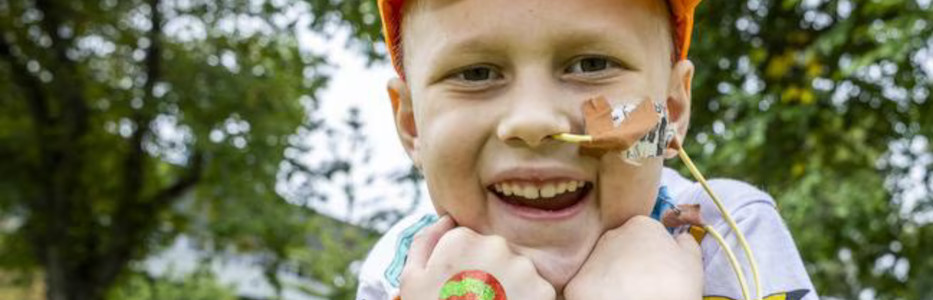
It was meant to be a fun family day at the beach; a relaxing way for the Thomas family to unwind after a hectic Christmas.
Jacqueline and Terry Thomas packed children Oliver, 6, and Piper, 2, into the car, beach-ready.
Ms Thomas remembered there was an urgent care clinic in Warrnambool on the way and suggested a detour to have a rash on Oliver’s chest checked out, more a precaution if he needed antibiotics.
“It wasn’t that bad looking, not itchy or bothering him at all,” she said. “We live in the country and I couldn’t get into a local doctor and I wanted to see what it was.”
It was a visit that would turn their world upside down.
Sent to the Warrnambool Hospital, a doctor there, who had also worked at The Royal Children’s Hospital (RCH) ordered urgent blood tests.
She hadn’t mentioned the word cancer; that would come a few hours later.
Within hours the family was being flown to Melbourne and Oliver was admitted to the RCH where clinicians worked with scientists at MCRI and confirmed he had phenotype acute leukaemia.
Tough to treat, but the team customised a treatment plan to reassure the family.
“My husband and I drove back home and picked up some things in the middle of the night while he was sleeping, but Ollie hasn’t been home since,” Ms Thomas said.
She also had to move to Melbourne where accommodation has been provided for the family by the Bone Marrow Donor Institute.
It has been a rollercoaster ride. Oliver’s treatment for the next few months will include chemotherapy and hydro steroids. His mum says the treatment is intense and makes him so nauseous he hasn’t been able to tolerate food for the last three weeks.
Ms Thomas says the team caring for her young son is fantastic and the family is forever grateful to be at the best children’s hospital with access to world-leading researchers who will aim to cure her only son.
Oliver
“We really trust that they have a plan,” she said.
“And so grateful that we have such a good healthcare system.”