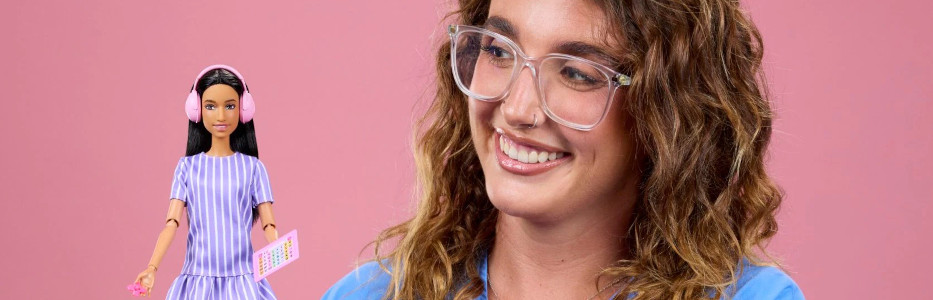
WELLINGTON: Barbie has been made autistic as part of a campaign to boost doll diversity.
Doll manufacturer Mattel has created the first Barbie with autism, a disorder with a spectrum of behaviours, seen by some charities as an “invisible disability”.
The toy, which launched in 1959, became known for its elongated frame and flowing blonde hair.
Hispanic and fuller-framed “curvy” models as well as Down’s syndrome and Type 1 diabetes Barbies have since been released following criticism over a lack of representation.
Toymakers have now sought to make autism visible with Barbie’s new body, which includes eyes that gaze slightly off-centre, intending to represent an autistic reluctance to make eye contact.
The elbow and wrist are more bendy, allowing children playing with the doll to mimic the repetitive hand-flapping that some autistic people use to express themselves or calm down.
Each autistic Barbie also comes wearing noise-cancelling headphones to limit overstimulation.
The doll’s other accessories include a fidget spinner to offer a “sensory outlet”, and a tablet showing a communication system used by those who have difficulty speaking.
Barbie’s latest iteration also wears a loose-fitting dress and flat shoes intended to reduce sensory stimulation from clothing.
The new model was designed with advice from the Autistic Self Advocacy Network in the US, and has been endorsed by autism charities in the UK.
Its launch follows a number of new Barbies that manufacturers created to increase the diversity of the dolls, the latest being the 2025 diabetes doll, complete with an insulin pump and glucose monitor.
In 2024, Mattel released the first blind Barbie, with a guide cane, and following on from the release of the first Barbie with Down’s syndrome in 2023.
Advertisement
Speaking at the time, Lisa McKnight, the executive vice-president of Barbie and Dolls at Mattel, said: “As the most diverse doll line on the market, Barbie plays an important role in a child’s early experiences, and we are dedicated to doing our part to counter social stigma through play.”
While recent models have focused on disabilities, the brand has also grappled with racial politics in recent years, and following the Black Lives Matter protest in 2020, it pledged to do more to increase the positive representation of black people.
Concern with racial representation has resulted in the limited edition “Ida B Wells Barbie”, a doll representing the early 20th-century African-American civil rights campaigner.
Other dolls in the Inspiring Women series have included the Rosa Parks Barbie, and a Maya Angelou doll.
Mattel has repeatedly updated its dolls in light of criticism about diversity, increasing the number of available skin tones in 2016, and in response to concerns about body image.
Fears that the impossibly lithe Barbie could prompt eating disorders in children hoping to emulate her figure led the company to release a “curvy” Barbie in 2016.
British charity the National Autistic Society has welcomed the most recent efforts to help children relate to their dolls, and represent behaviours associated with the often invisible condition.
Peter Watt, the managing director of the society, said: “Seeing more depictions of autism is key to understanding and autism acceptance.
“It’s really important that these representations are authentic and based on extensive consultation with autistic people, and we’re pleased Mattel involved the autistic community in the development of this doll.”
One of those consulted was British autistic influencer Ellie Middleton, who uses her online platform to discuss the condition, and her ADHD.
She said: “To now have an autistic Barbie doll makes me so emotional. Statistics show that young girls are often undiagnosed or misdiagnosed, so to have a powerful symbol like this autistic Barbie doll helps bring the conversation around neuro-divergence in women to the forefront, so that autistic girls can feel accepted and seen.”