SINGAPORE: A little after 8am on Thursday in the Superior Court building in downtown Los Angeles, the doors to Room 12 swung open. Lawyers started lugging in their materials. Handcarts stacked high with boxes, bursting with documents, creaked and squeaked as two sides readied for battle.
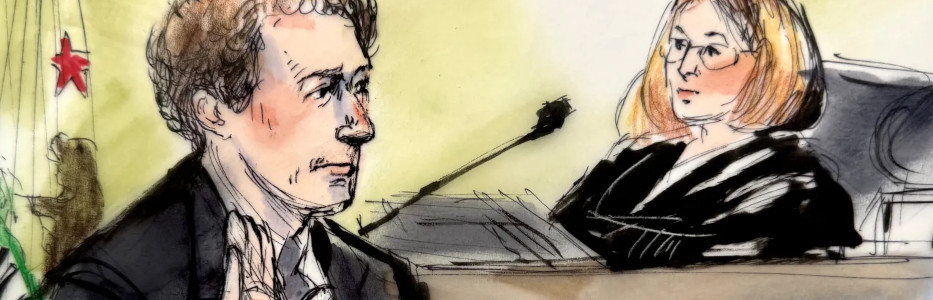
The gallery of observers and press, dotted through three rows of hard, wooden benches, rose as the seventeen jurors filed into the courtroom — 12 core members plus five alternatives in case anyone had to drop out — followed by the judge, Carolyn Kuhl. “Good morning, everyone,” Kuhl said. “Everybody may be seated.” Another day had begun in the landmark trial that could prove a turning point for the multitrillion-dollar social media industry.
Meta and YouTube, the defendants, are fighting allegations that they wilfully built addictive products that harmed the mental and emotional health of a 20-year-old woman named Kaley. Known in court documents as KGM, she started posting videos on YouTube aged six and claimed that by adolescence she was addicted to apps including Instagram, Snapchat, TikTok and YouTube. As a result, she claimed to suffer body dysmorphia, anxiety, depression and engaged in self-harm. (TikTok and Snapchat, which were also defendants, settled days before the case started last month.)
Kuhl chose KGM’s case as a bellwether of the more than 1,200 lawsuits that have been filed in state courts in the US. For Meta and its ilk, the stakes are high. Because the evidence and many of the arguments in this trial will be broadly similar to the other handful that Kuhl has chosen to follow in quick succession, the verdict will be seen as a sign of what is to come.
KGM’s lawyers are seeking unspecified damages and, crucially, to establish a new legal theory: that social media companies can be held liable for the “addictive” design of their products. Such a precedent would be likely to force the companies to significantly overhaul how they design their apps, which today are studded with features such as “infinite scroll” and autoplaying videos, one after another, that are highly effective at keeping people on their screens.
A loss for KGM could dash the hopes of plaintiffs still in the queue. Critics argue the industry has arrived at its Big Tobacco moment, which they hope could lead to a master settlement akin to the one from the tobacco companies when they agreed, in 1998, to pay $206 billion into a fund covering the health and societal costs of smoking.
Inside court, the scene was cinematic
On one side sat KGM’s legal team: Mark Lanier, a devout Christian from Texas with a folksy delivery that was part preacher, part teacher. Lanier, who owns “one of the nation’s largest private theological collections”, is partial to using large coloured pencils to highlight passages, doodle and write out key points as witnesses talk on the stand. Lanier has won more than $20 billion in product liability damages in cases ranging from asbestos exposure to opioids. His co-counsel: two of his daughters. (Lanier has five children.)
On the other side of that family affair was arrayed a phalanx of corporate superstars: at least eight lawyers from Covington & Burling, the elite Washington firm known for, among other things, its defence of the National Football League in concussion-related cases, and Wilson Sonsini, a West Coast firm favoured by Big Tech.
It is the best defence money could buy.
And their audience? A diverse jury, ranging from twentysomething Latinos to Asian senior citizens; African-American men to white women. It will be up to them whether this is indeed social media’s moment of reckoning, 22 years after Mark Zuckerberg founded Facebook and kicked off the era of mass social media. The trial is set to wrap up, under the judge’s orders, by March 20.
‘If I didn’t get likes, I’d feel ugly’
In the middle of it all is KGM, a 20-year-old from Chico, California, who testified last month about how she had begun using social media apps compulsively from a young age. By ten years old, she was depressed and cutting herself. “When I got a bunch of likes, I was really happy,” she said. “If I didn’t get a lot of likes, I would feel I shouldn’t have posted it, I was ugly.” At one point Lanier unspooled a 10m-long banner of photos KGM posted on Instagram. “Almost all”, she testified, had one of the “beauty” filters that allows people to change their appearance.
A former therapist said in court that social media exacerbated KGM’s struggles. A psychiatrist said that she met the symptoms of social media addiction.
Zuckerberg, the Meta chief executive, and Adam Mosseri, the head of Instagram, both denied in court last month that their apps were designed to be addictive. Instead, their lawyers have sought to frame KGM as a deeply troubled person who was neglected and abused in an unhealthy household, backing up their claims with hundreds of pages of medical records and psychological evaluations.
“The question for the jury in Los Angeles is whether Instagram was a substantial factor in the plaintiff’s mental health struggles,” Meta said last week. “The evidence will show she faced many significant, difficult challenges well before she ever used social media.”
The case is one piece of a long-building backlash that has begun to spread far beyond the wood-panelled walls of the Los Angeles court. In December Australia became the first western government to ban social media accounts for under-16s. In New Mexico a similar case to KGM’s, brought by the state attorney-general, was winding towards a conclusion last week. In Washington, parents who have lost children to suicide or dangerous social media challenges flew in to protest against what they claim is a watered-down child safety bill that would undermine their efforts to hold the industry to account.
The whistleblower
After nearly three weeks making his case, Lanier called his last witness on Thursday. Arturo Béjar is a Meta safety executive turned whistleblower whom the company originally brought in as one of “fewer than ten people in the world” qualified to do the type of safety and wellbeing work he was hired for in 2009. A former insider — Béjar worked at Meta from 2009 and 2015 and as a part-time consultant between 2019 and 2021 — he was deployed by Lanier to poke holes in the narratives presented by Zuckerberg and Mosseri.
The Meta executives said safety was paramount and that the company went to great lengths to keep under-13s off their apps. Under US law 13 is the minimum age to open a social media account.
Béjar said these public statements were “just not true”. He accused the company of “safety theatre” that “profoundly misled” children and parents about the harms of social media. To prove the point Béjar conducted a simple test last year, by which time Instagram had announced more than 50 tools and design changes to improve safety.
He created a fake Instagram account for a 13-year-old. After clicking on a single gymnastics video, he was led to a series of video reels, including a feed of girls lip-syncing to a song with the words, “My name, my age, my favourite colour,” as they pointed to digital images showing the answers to those questions. The unedited scroll that he recorded, and that was shown in court, displayed a stream of girls claiming to be between the ages of nine and twelve.
Béjar said he found “thousands” of posts from underage users via similar tests. “If I was able to, that easily, find that many kids saying, ‘I’m seven’, or ‘I’m six’, and whatever, what it really means for a service that has a billion people is that there are millions and millions [of underage children].”
Creating a screening system, he added, could be “done with one click”, but he argued that the company deliberately made reporting tools cumbersome so that fewer people would get pushed off the platform, while “tragically underfunding” the wellbeing teams charged with creating such tools.
‘You don’t know at all, right?’
When it was her turn, Phyllis Jones, Instagram’s lead lawyer, sought to undermine Béjar’s credibility piece by piece, starting with a moment of theatre.
As she prepared to cross-examine him, Jones asked the judge if a lawyer from her team could “hand Mr Béjar a few things”. The things in question turned out to be an immense tower of binders and testimony transcripts, thousands of pages from a previous deposition that Béjar had given. “I hope I can see through the binders,” Béjar said sheepishly as he arranged the materials.
Jones then compared his testimony with what he had said in the deposition months earlier, picking up on the slightest inconsistency and framing him, broadly, as a part-time consultant who worked as little as three hours per week and who had little knowledge of the Meta empire’s safety efforts. When she asked him the headcount and resources of a Meta department, she said: “You just don’t know at all, right?” Over and over, she got him to say, “I don’t know” in what seemed to be a deliberate attempt to chip away at what might have been seen by the jury as authoritative testimony.
At 4.30pm the judge called it a day, thanking the jury for their time and urging them to speak to no one about the case. They would be back the next morning — the first where Meta and YouTube can start to make their cases after nearly three weeks on the defensive.
As she prepared to cross-examine him, Jones asked the judge if a lawyer from her team could “hand Mr Béjar a few things”. The things in question turned out to be an immense tower of binders and testimony transcripts, thousands of pages from a previous deposition that Béjar had given. “I hope I can see through the binders,” Béjar said sheepishly as he arranged the materials.
Jones then compared his testimony with what he had said in the deposition months earlier, picking up on the slightest inconsistency and framing him, broadly, as a part-time consultant who worked as little as three hours per week and who had little knowledge of the Meta empire’s safety efforts. When she asked him the headcount and resources of a Meta department, she said: “You just don’t know at all, right?” Over and over, she got him to say, “I don’t know” in what seemed to be a deliberate attempt to chip away at what might have been seen by the jury as authoritative testimony.
At 4.30pm the judge called it a day, thanking the jury for their time and urging them to speak to no one about the case. They would be back the next morning — the first where Meta and YouTube can start to make their cases after nearly three weeks on the defensive.