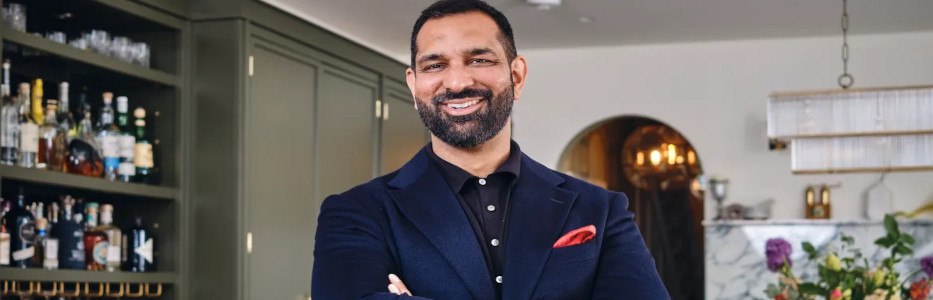
SINGAPORE: A young entrepreneur has built a home care provider empire in under seven years.
Amrit Dhaliwal grew up waking at 4am on Saturdays to help his father set up market stalls across the country. His favourite was Blackbushe market in Hampshire, mainly because he was allowed to visit the sweet shop.
“It was super fun for me because it was like being on a school trip, but it was an everyday occurrence for my dad,” said Dhaliwal, who chatted with the shoppers from the age of four. “I was learning how to speak to customers and make eye contact with people and give them the product.”
The early work experience has paid off for Dhaliwal, now 39, who has since sold three businesses and founded his fourth, called Walfinch, in 2019. Walfinch is a home care provider that franchises the right to provide its services in different parts of the country to independently owned companies. These employ carers who supply privately paid-for services such as medication assistance, meals, exercise classes and companionship for vulnerable adults, often in their own homes.
The total franchise network operates across 36 areas of the UK and turned over £18.5 million in 2025, making a pre-tax profit of £1.1 million.
Dhaliwal grew up in Southall, west London, after his parents emigrated from villages in Punjab in India. His father arrived in Britain in January 1976 with just £3. Both parents worked in factories before building market and retail businesses.
They bought their first shop in 1987, the year in which he was born. They began by selling Indian clothing but this gradually morphed into a household goods business with multiple sites. Dhaliwal attended The Heathland School in nearby Hounslow and spent evenings helping in the shops.
“It wasn’t called entrepreneurialism to [my parents],” he said. “They were just in survival mode because there was nothing else they could have done to raise four children and have a sustainable life. They had to run businesses.”
Nevertheless, Dhaliwal believes he inherited an entrepreneurial spirit. By the age of 10, he was selling posters of the footballer Ryan Giggs in the playground, and, at 14, he was arranging staff rotas for the shops any time that his parents were away. As a teenager and student he tried several ventures, including selling martial arts equipment and wholesaling perfumes.
After studying economics and history at Keele University, he spent eight months working in headhunting. Although he was successful, he realised corporate life was not for him. Dhaliwal recalls a senior colleague who talked about opening a restaurant one day. “I remember thinking, ‘Why one day? Why not today?’ I made the decision at that point to go off and do my own thing.”
At the age of 22, to the dismay of his parents, he left recruitment and bought an Italian deli in Richmond, southwest London, drawing on loans and bank overdrafts. “I had literally no idea what I was doing with it.” He hadn’t negotiated a proper handover from the old owners, didn’t understand the wine list or how to use the coffee machine, and didn’t even have a chef lined up. “All of a sudden, it was very, very scary,” he said.
Dhaliwal learnt how to run the business with the help of older staff members, but it soon ran low on cash. “The summer in Richmond is great,” he said, “but who knew the winter wasn’t and no one’s around any more?”
At the time, he was reading Sir Richard Branson’s autobiography, Losing My Virginity, which inspired him to invest his way out of trouble. He took on a neglected boutique nearby and transformed it into a Marie Antoinette-style tearoom. It was popular, winning a local award, and allowed him to upgrade the deli into a fine-dining Italian restaurant called Amadora.
The years in Richmond also taught him social and business skills that he felt he had missed during his upbringing. “Growing up in Hounslow and Southall, in this immigrant-heavy community, you don’t get the same soft skills,” he said. “I remember relearning lots of things in my early twenties — re-learning how to speak, re-learning all of those base-level social skills. I felt very alone.”
Around this time, Dhaliwal met his now wife, a dentist, who introduced him to the concept of domiciliary care, which involves trained carers visiting a person’s home to help them with daily tasks. He began researching home care franchises around Britain and then went on to sell the tearoom for £50,000, using the proceeds, along with a NatWest start-up loan from its franchise team, to buy his first home care business, SureCare Oxfordshire, in September 2012.
“I thought, ‘Gosh, what the hell have I done?’ ” he recalled. “That’s when it clicked for me that home care and franchising were both broken. Fixing franchising in the home care space became my mission.”
For 18 months, Dhaliwal commuted for up to five hours a day between Oxfordshire and Richmond while using profits from Amadora to support the care business. Once the operation was up and running, he also sold the restaurant to focus on care full time.
Dhaliwal also sold SureCare Oxfordshire in 2018 and used that treasure chest to start Walfinch the following year, boosted by a £200,000 loan from the provider Funding Circle. His goal was to modernise the care sector, and the franchise model, by turning the average person into an “above-average entrepreneur”. It has taken almost £1 million to get the business to the place it is in now.
He sold his first franchise in December 2019, just a few months before the Covid lockdowns began. “It was absolutely brutal that first year,” he said. “It was in many ways one of the hardest times to start anything.” As well as building a franchise network, Walfinch had to interpret rapidly changing government guidance for franchisees.
Dhaliwal said he is “super, super selective” about prospective franchisees and sets up meetings only with a handful, remembering some advice his father gave him. “When I was a boy, my dad said to me, ‘It takes a lifetime to build a good reputation, but you can ruin it in seconds.’ ”
Most Walfinch branches are rated “good” or “outstanding” by the Care Quality Commission (CQC), the industry regulator. Because Walfinch operates as a franchise network, each branch is independently owned and responsible for its own inspections. Dhaliwal directly owns and operates one in Oxfordshire, which is rated “good”, as well as another temporary branch that holds the same rating.
Ask me anything
-Turning point … Meeting my now wife changed everything in my life. She’s shaped so many decisions.
-Best business tip … Obsession is OK, but know that you are going to give something up. I’m deliberate about spending time with my children, my wife and my business. Everything else cannot happen.
-Someone I admire … My father is my inspiration. He came to the UK and learnt through books and trial and error.
-Worst decision … I don’t really believe in mistakes, but I think my worst decisions have been where I’ve tried to carry too much myself, instead of bringing in the right people around me sooner.
-Best way to start the day … I have three kids who often start the day for me! But if I can get to the gym, have two coffees and three minutes of mental peace, that is a great way to start the day.
The CQC rated two Walfinch services as “requires improvement” in 2021 and 2022, and served a further one with a warning in 2025. Walfinch said the issues at all three branches have been resolved and verified by the NHS and local councils, but the ratings remain public due to the CQC’s continued inspection backlog; it had planned to conduct 16,000 assessments in 2025, but achieved only 3,825, leaving many reports more than four years old.
“We’re in active dialogue with [the CQC] and we’re confident these ratings will be updated once they’re able to return,” Dhaliwal said.
He believes the sector must improve conditions for care workers and rethink how Britain supports an ageing population. “The way we deliver care within the sector has not really changed in the past 20 or 30 years,” Dhaliwal said, adding that he wishes there was more emphasis on longevity, preventative care and wellness for older people. “Not just, ‘We’re coming in, we’re giving you medication, we’re doing your breakfast and shower, and then we’ll come back at midday.’ ”
He still thinks a lot about where he came from. Growing up, Dhaliwal said, he often felt out of place in the business community. “But actually, you have to keep feeling out of place for you to eventually be in the right place.
“One of the things that I really believe in is having hope and anyone can do it, because I’m just a boy from Southall. There’s nothing special [about me] apart from the fact I was willing to do the work, and anyone from anywhere can do work and change their destiny.”