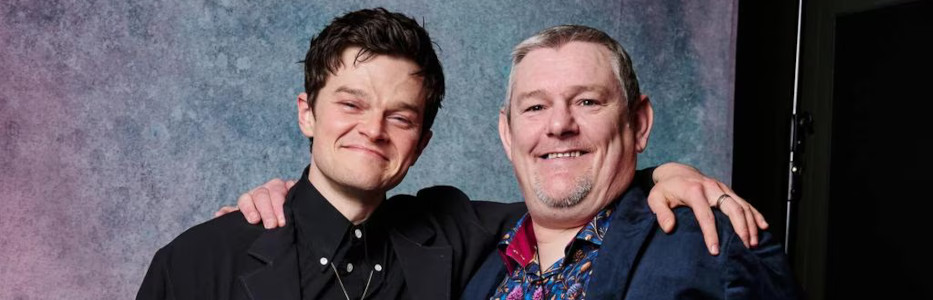
SINGAPORE: ‘F..k the Queen!” are the few choice words lobbed in the opening moments of I Swear, a biopic about Scottish Tourette’s campaigner John Davidson. It is not artistic licence. Davidson really did let that obscenity rip at the Palace of Holyroodhouse in 2019 (he also called King Charles a “f..king parasite”). He was there, looking smart in a tuxedo jacket and tartan trousers, to receive an MBE for his efforts to educate the British public about the neurological condition he has lived with since his teens. The late Queen, by his account, did not flinch.
“She was as calm and assured as my granny,” he later said.
Director Kirk Jones opens with the moment to “let people know they can laugh”.
“I like taking audiences on that emotional range. I think they can handle humour and emotion together,” he tells Culture over Zoom.
Laugh you will. Cry too, and not prettily. I Swear belongs to a strain of British filmmaking that has become somewhat quaint: the earnest, crowd-pleasing social realist, in the lineage of The Full Monty. It toggles between humour and pain because its subject’s life has done the same. “When I first met John, I said, if I identify a level of humour, would that upset you? He said no,” Jones says. “He said his life has been hilarious and tragic at the same time. He meets someone, says something inappropriate, they know him and support him. Then he’ll go into a shop, say something inappropriate to someone who doesn’t know him, and they react badly. Every hour for John is different.”
Jones first encountered Davidson’s story in the BBC documentary John’s Not Mad. Filmed in 1989, when Davidson was 15, it turned him into the poster boy for what was then a poorly understood condition. “I never forgot it,” Jones says. Years later, after a run in America making glossy studio fare (What to Expect When You’re Expecting, My Big Fat Greek Wedding 2), Jones felt the pull back. “I really wanted to do something in the UK that I felt passionate about.”
So he went looking for Davidson. Or, more precisely, “went up to Galashiels and knocked on his door”. What followed was an attempt to understand the man beyond the diagnosis. “I felt that John’s life was so extraordinary, tragic, emotionally engaging and humorous,” he says. “For me, his story didn’t just last for the few weeks the documentary crew were with him. It deserved to be told as a feature.” He admits that he spent their three days together with a persistent, low-level anxiety that Davidson would turn around at any moment and tell him that someone had beaten him to it. “Sometimes you cannot believe you’re the only person who’s had the idea to make a film like this.”
That anxiety extended to the financing. Jones deliberately kept the budget low to retain creative control. “I’ve been making films long enough now to know that the bigger the budget, the more people there are involved, the less control I have and the more political the process gets,” he says. Even so, the £5m ($9m) production was a scramble: he put his house up as surety, while producer Piers Tempest waived his fee. Securing a 15 certificate proved another hurdle, courtesy of the film’s 26 uses of the c-word.
We first meet Davidson as a teenager (Scott Ellis Watson, in his debut), an unfailingly polite, football-mad kid. Then the symptoms arrive: blinking, jerking, spitting, vocal tics. It is the late 1980s, in a Scottish small town where understanding of Tourette’s is thin to non-existent. He is bullied at school and caned by his headmaster. At home, his father retreats to the pub, unable to cope. His mother, a nurse played by a flinty Shirley Henderson, holds the line. One scene is hard to shake: a 14-year-old Davidson wading into the icy River Tweed, trying to take his life. In John’s Not Mad, he spoke about his suicidal ideation plainly: “Some of the time, I just feel like killing myself. It feels so bad.”
As an adult, Davidson is played by Robert Aramayo in a performance that is both technically precise and emotionally exposed. It won him a surprise BAFTA, beating a field of flashier names including Timothee Chalamet, Leonardo DiCaprio and Michael B. Jordan. Aramayo looked like a stunned mullet – mouth agape, eyes wide – when his name was called.
The career-defining moment was quickly eclipsed by controversy. During the ceremony, Davidson, attending as a guest, involuntarily shouted the N-slur while Sinners stars Michael B. Jordan and Delroy Lindo were presenting. The BBC did not edit it from the broadcast. Davidson left early and later apologised: “I am and always have been deeply mortified if anyone considers my involuntary tics to be intentional or to carry any meaning.”
The reaction exposed how poorly Tourette’s is still understood. Some were sympathetic; others were not. Among them was the Oscar-winning actor Jamie Foxx, who wrote: “Unacceptable … Nah, he meant that.”
Tourette’s is routinely reduced to swearing, though coprolalia – the involuntary blurting of obscene or taboo words – affects only a minority of people with the condition, roughly 10 per cent. Davidson experiences an extreme form. As Aramayo puts it: “It’s very rare that anyone just has Tourette’s syndrome. There are comorbid conditions. John has levels of ADHD, levels of autism, high anxiety.”
Aramayo, who grew up in Hull and trained at Juilliard (after Googling “best acting school in the world”), landed the role without auditioning. He is best known for playing young Ned Stark in Game of Thrones, and for his role [as Elrond] in the costly Amazon Lord of the Rings adaptation.
To prepare, the 33-year-old decamped from New York to Galashiels for a month to spend time with Davidson. They walked his dog, watched football, chewed the fat. “I think there’s a certain energy that you can pick up from a place and from a person just by being with them,” he says.
“It was enormously important that I went there and spent so much time with him.”
“We were developing the script during that time,” he adds. “There were constant conversations going on between all of us. It felt really intimate, like a little family. It was really creative.”
Some of the film’s most specific details emerged from those weeks. Aramayo would call Jones with new observations, including Davidson’s compulsion to snog lampposts that are “not straight, in a line, or the right colour”. “He’d literally call me in the evening and say, ‘Did you know this?’” Jones recalls. “And I’d say, I had no idea. But that’s great. I’m going to put that in.”
For Aramayo, the key to avoiding a studied performance was “developing John’s emotional response to what was going on with him. This is a biopic about John Davidson. It’s not a story about Tourette’s syndrome. There was a big focus on just trying to tell his story authentically.”
There were early discussions about casting an actor with Tourette’s. Davidson himself was tested on camera, but the experience was disastrous. Instead, the production brought members of the Tourette’s community into the film, most notably for an awareness-day sequence shot in the real community centre where Davidson works. “It was one of the most extraordinary and rewarding scenes that we shot,” Jones says. Of a cast of 90, roughly a third had Tourette’s or a related condition. “There was a level of improvisation there,” he says. “The kids just behaved as they wanted to behave. I wasn’t specifically directing them.”
Aramayo had to respond in real time. “Rob was performing with his script, but improvising at the same time based on what people were saying or shouting out.”
In one scene, he addresses the real parents of children with Tourette’s. Jones remembers watching the monitor and realising that the emotion in the room was not acting. “I saw a couple of people crying, and for a moment, I forgot they were real parents. I thought they were background artists. But they weren’t. When Rob said, ‘Don’t be hard on yourself, support each other, you’re not superhuman,’ they knew exactly what that meant.”