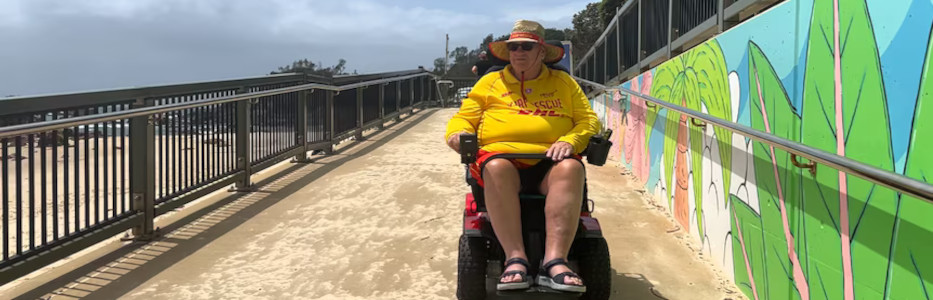
LOS ANGELES: Michael Lord has been using a powered wheelchair for the past six years after being diagnosed with a degenerative neurological condition, cerebellar ataxia.
He has been a volunteer surf lifesaver at Port Macquarie’s Flynns Beach for the past two years.
Volunteering Australia says barriers remain for the disabled community.
Surf lifesaver Michael Lord patrols the coast a little differently on a popular New South Wales mid north coast beach.
The 70-year-old uses his all-terrain wheelchair to carry out his daily duties, from setting up the flags to looking out for rips at Flynns Beach at Port Macquarie.
“I help identify rips and things on the beach … set the flags where they need to go, keep an eye on those danger areas … all the volunteers I serve with are just fantastic, they are absolutely fantastic,” he said.
“It’s unusual to see a lifesaver in a wheelchair and it’s unusual to see a lifesaver with purple and green hair — both are conversation starters.”
A man in a wheelchair with sunglasses smiles looking away from the camera.
Mr Lord was diagnosed with a degenerative neurological condition, cerebellar ataxia, in 2016.
The condition affects the area of the brain called the cerebellum and can result in difficulty executing voluntary movements.
“There were some days where I woke up and … I just wanted to give up,” he said.
“It [surf lifesaving] helps me to keep thinking, ‘Well, I can do things and if it helps someone in the community, then it’s worthwhile.’”
Christine Lord said her husband’s diagnosis was difficult to deal with.
“He needs to do stuff that is for himself and makes him feel worthwhile, because he has lost so much,” she said.
“[He] woke up one day and decided he wanted to go be a volunteer surf lifesaver,” she said.
A call to the Port Macquarie Surf Lifesaving Club got the wheels in motion.
“I thought it would be nice to reach out and see if I could do something, just be an extra pair of eyes on the water,” he said.
The club’s director of lifesaving, Melinda Cockshutt, said Mr Lord had become an “invaluable member of our team” since joining in 2024.
“We work with his strengths, just like we would with any other member of our patrol,” she said.
“It just goes to show that you don’t have to be super amazing in the water, there is a role for everyone here at the beach.”
Mr Lord’s training began with a radio operator’s certificate, which equips surf lifesavers with the skills and knowledge to operate communications systems and equipment in surf lifesaving operations.
A first aid certificate followed.
“Breezed through that online,” Mr Lord said.
But the CPR component required a little help from his friends.
“They [other volunteers] were able to help me get out of the chair and onto my knees … and I started to do compressions and was able to pass that [CPR] too,” he said.
But the real game changer came in the form of an all-terrain wheelchair, delivered in December 2025 and funded through the NDIS with support from the club, local council and politicians.
“I can now access the beach and be a fully fledged lifesaver,” Mr Lord said.
“I can’t go in the water but I can use the radio to alert those that can to get in the water if needed.”
The community reaction has been positive.
“I have people that come up and say thank you for what you are doing,” Mr Lord said.
Monthly visits to Flynns Beach by the local Disabled Surfers Association are particularly rewarding.
“The participants come up and give me a hug,” Mr Lord said.
“It makes it quite a special day.”
Ms Cockshutt said Mr Lord’s presence on patrol had been a massive boost to the club.
“People go up to him and ask him questions and they don’t feel afraid to,” she said.
“Michael is a great communicator, which is why he is a great team member.”
Surf Lifesaving Australia is working on consolidating its data about people with disabilities who volunteer.
“We are trying to improve the visibility that people with a disability can be a surf lifesaver,” participation coordinator Sharon Deans said.
“You can’t be what you can’t see.”
Mr Lord said he hoped more people living with a disability would feel empowered to volunteer.
“No matter how bad your situation is with your disability … there are definitely things you can do to serve your community,” he said.
“Just reach out.”