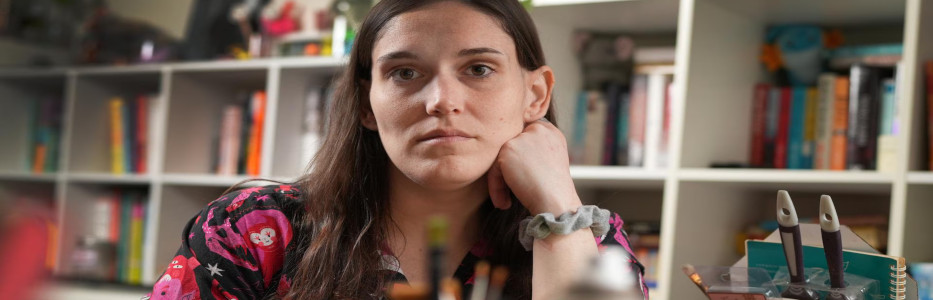
SINGAPORE: A woman has shared her long battle with complex mental illness and trauma, saying repeated hospital discharges and service gaps have left vulnerable patients falling through the cracks.
Mikki. Abbie. Christopher. Lucy. Aly. Leah. Bear. Jada.
These are the names of eight friends that Amy Passmore carries close to her heart, after spending more than a decade in South Australia’s mental health system.
The 29-year-old from Klemzig, has battled complex trauma, eating disorders, borderline personality disorder, autism, psychosis and chronic illnesses while repeatedly cycling through hospitals and psychiatric care – but says the loss of multiple loved ones to suicide and medical disorders have been the hardest hits.
“I’ve done the silliest of things that I shouldn’t have done,” she said.
Childhood sexual abuse has also shaped many of her struggles with food and self-worth.
Ms Passmore said she was repeatedly turned away from psychiatrists because she was considered “too much of a liability”.
“I’ve had so many psychiatrists say, no, I don’t want to see you because of your history, because you’re a liability,” she said.
“No one would take me on because I’m too much of a liability.”
She said many of her friends lost hope after being discharged from hospital despite seeking urgent help.
“They were discharged after constantly being told, ‘No, you can’t be here’,” she said.
“You’re not poorly enough. You’re not sick enough. We’ve got other people we need to help.”
Data from the Australian Institute of Health and Welfare (AIHW) shows in 2014-15, SA accounted for nearly 24 per cent of the national residential mental-health care capacity, with 1857 available places out of a national total of 7787.
But today that share has plummeted to fewer than 8 per cent. By 2023-24, SA’s capacity dropped to just 702 places, while the national capacity grew to 9137.
Royal Australian and New Zealand College of Psychiatrists SA branch chairman Dr Devon Marshman said the nation’s psychiatrists were struggling with shortages in staffing and beds. “The combination of more people presenting and significant shortages means that contact can be unfortunately brief, and that is disappointing for patients,” he said.
“But it also means that access to psychiatrists is spread really to as many people as possible.” He said nationally there were “significant increases in, to a certain extent, mental-health awareness, mental-health literacy within the population anda greater actual uptake of psychiatry services”.
“That is a pretty large demand, but it does have ramifications in terms of workforce, treatment, accessibility,” he said.
SA was also facing long-term workforce pressures, with many psychiatrists nearing retirement.
This article contains features which are only available in the web versionTake me there
But Dr Marshman said recent investment in new rehabilitation wards in local SA health networks might influence change in the system.
The collapse in care capacity has occurred despite a growing workforce in the past decade. AIHW workforce data reveals the number of full-time equivalent psychiatrists in SA grew by 24.3 per cent over the past decade, rising from 251 in 2013 to312 in 2023.
Nationally, the workforce had an even sharper increase of 33.2 per cent, reaching more than 4000 specialists.
Ms Passmore was one of many facing a constant turnover of psychiatrists, which created difficulties forming proper relationships or feeling understood.
“I could not handle having a public psychiatrist or psychologist for too long, because every few months, they’re like, ‘oh, we’re swapping them out now’,” she said.
This article contains features which are only available in the web versionTake me there
Since her last attempt on her life five years ago, Ms Passmore has been clean and studying to receive her certificate IV in mental health and peer work, with hopes of using her lived experience to create change within.
“I’m using the disadvantages that the system has given me or that happened to me and I want to turn that around by working in the system,” she said.
“I don’t want that to continue happening. “I want people to know there is hope.”